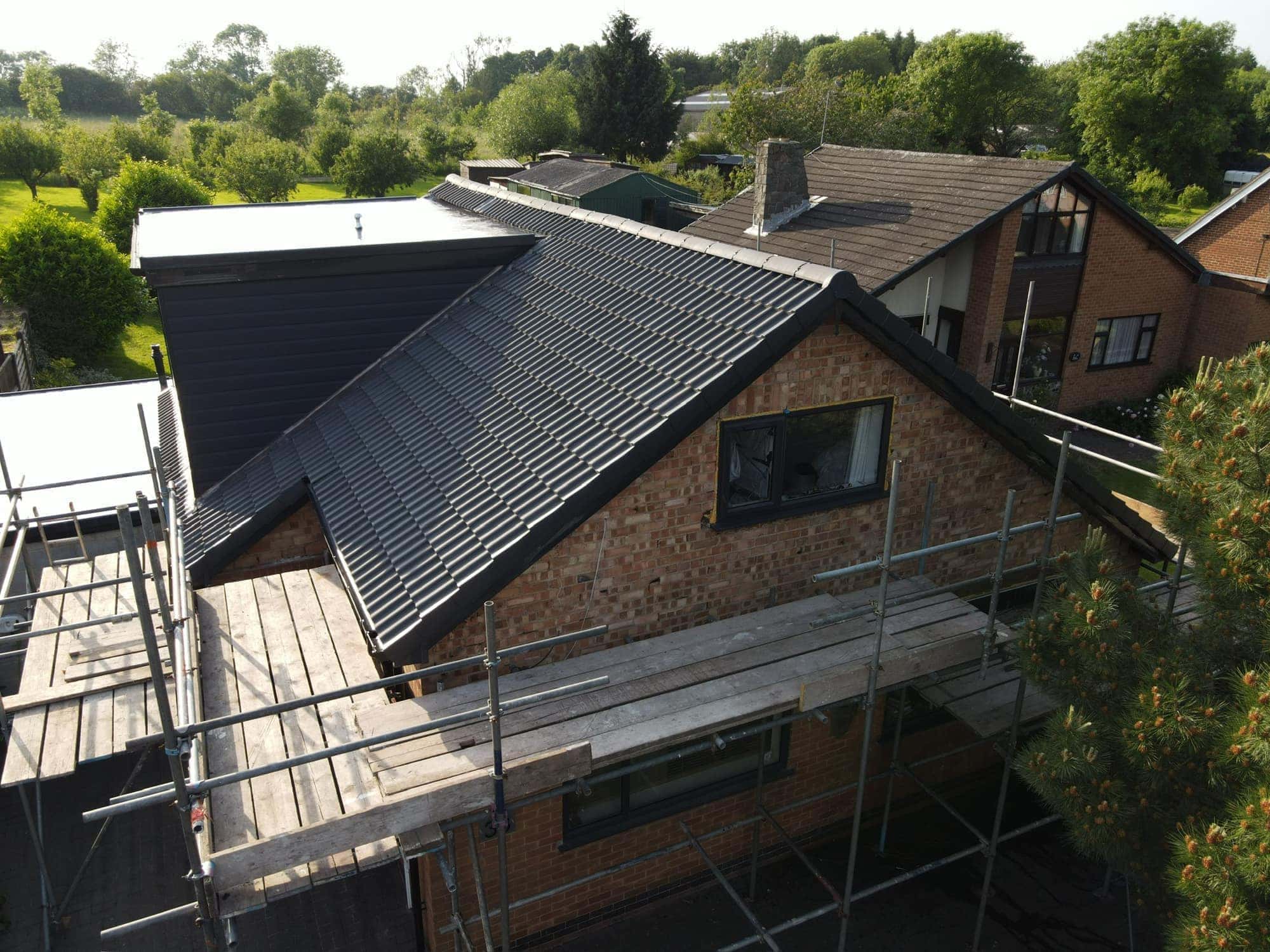
Roof Repairs in Kirk Ella
The more complex a roof, the more places it can leak — and Kirk Ella's larger detached and period homes, with their hips, valleys and multiple junctions, prove the point.
Learn more →Kirk Ella and West Ella are among the area’s most desirable villages, with larger detached properties and period homes around the old village core near Church Lane. Bigger houses mean more complicated roofs — multiple pitches, valleys, dormers and several chimney stacks on one property — and the mature trees that line these streets steadily fill those valleys and gutters with debris. Careful repairs, re-roofing, chimney work and detailed leadwork in valleys and around stacks are what these roofs need, and matching the quality of the property is the standard we work to.
Free quotes · £5 million public liability · 15-year guarantee
The oldest houses are concentrated along Church Lane, where merchants and shipowners from Hull moved out of the city from the 1750s onwards. The council’s conservation area appraisal reads the village through three architectural periods — eighteenth-century Georgian, nineteenth-century Gothic Revival, and inter-war derivatives of Mock Tudor and the Arts and Crafts movement — and each brings its own roof shape and detailing.
Growth then came quickly. Semi-detached and detached houses with large gardens went up through the 1930s in such numbers that by the 1940s they greatly outnumbered everything standing before the 1920s. Welsh and Westmoreland slate, plain tiles and some clay pantiles are all recorded in the conservation area, and the appraisal’s own impression of it is of 1930s to 1960s suburban houses under slate.
Ground rises from about 10 metres above sea level in the east to 40 in the west, and keeps climbing to the 40 to 60 metres of the Wolds foothills at West Ella. Height and exposure give the wind a clear run at a ridge or verge. Slate generally fails at its fixings rather than in the stone, so a slipped course is worth acting on early.
An area taking in St Andrew’s Church, Church Lane and parts of Packman Lane and Godmans Lane has been a conservation area since 1974, and includes Grade I and Grade II listed buildings. Swapping the covering, a front-slope roof window, or removing a chimney could need planning permission or listed building consent - East Riding of Yorkshire Council is the first point of contact.
Everything we do for Kirk Ella homeowners — tap a service for local detail.
The more complex a roof, the more places it can leak — and Kirk Ella's larger detached and period homes, with their hips, valleys and multiple junctions, prove the point.
Learn more →Re-roofing a substantial Kirk Ella home is a different undertaking from a standard semi, with multiple pitches, dormers and chimney abutments all needing careful detailing.
Learn more →Behind many of the large detached houses off Packman Lane sit flat roofs doing quiet service over garages, rear extensions and dormers.
Learn more →Slate sits handsomely on Kirk Ella's period homes, and with a lifespan that can exceed eighty years it rewards proper installation.
Learn more →Mature trees make West Ella and Kirk Ella beautiful, but in a winter storm a falling branch can open a roof in seconds.
Call 07447 352091Learn more →Deep eaves and long roofline runs are typical of the bigger homes along Packman Lane, and the original timber fascias there have often been painted over rot rather than replaced.
Learn more →We supply and fit cast iron, cast aluminium, timber and lead guttering across Hull, Beverley and the East Riding, plus Twinplas — a twin-wall PVC box gutter made as a like-for-like replacement for the timber troughing on Victorian and Edwardian terraces — because not every roof suits white plastic.
Learn more →Twinplas is a twin-wall PVC box gutter made specifically to replace the timber trough gutters found on Victorian and Edwardian terraces and barn conversions.
Learn more →We regularly work on Grade II listed buildings across Hull, Beverley and the East Riding — from a detailed roof assessment at Lockington House, a Grade II listed former rectory, to an ongoing programme of lead work, ridge and verge work and like-for-like tile replacement on a listed property in Walkington.
Learn more →Multiple chimney stacks are almost a Kirk Ella trademark — many period homes around Church Lane and West Ella carry two, three or more, each one exposed to the weather on every side.
Learn more →Tree cover is part of Kirk Ella's charm, but the shade it casts over roofs along Beech Hill and Packman Lane gives moss ideal growing conditions.
Learn more →Loft conversions are a natural fit for Kirk Ella's larger detached homes, where the generous roof spaces off Beech Hill often have head height to spare.
Learn more →Replacing a conservatory roof turns a room that bakes in summer and freezes in winter into one you can actually use all year round.
Learn more →Detailed lead work is what separates Kirk Ella's finest period roofs from ordinary ones — stepped flashings climbing multiple chimneys, lead-lined valleys between pitches, and bay window tops that have kept the weather out since the houses were built.
Learn more →Woodworm is the larva of a wood-boring beetle — in East Yorkshire homes usually the common furniture beetle — tunnelling through rafters, purlins, joists and floorboards in the roof space.
Learn more →How do you check a roof with three chimneys, hidden valleys and slopes facing every direction?
Learn more →As well as Kirk Ella itself, we regularly work in West Ella, Beech Hill, Church Lane, Packman Lane and across the HU10 area. Wherever you are, you get the same insured, guaranteed roofing work and an honest assessment of what your roof actually needs.
Yes — Armour Shield Roofing Services covers Kirk Ella (HU10), including West Ella, Beech Hill, Church Lane, Packman Lane. Every quote is free and no-obligation, and our workmanship is guaranteed in writing for up to 15 years.
The appraisal records slate, plain tile and some clay pantile in the designated area, and in a conservation area like-for-like replacement is normally what is expected. Changing to a different covering may need permission, and on a listed building the work needs listed building consent. The planning authority here is East Riding of Yorkshire Council, so it is worth asking before materials are chosen rather than after.
Substantial growth came in the 1930s, and within a decade those houses outnumbered everything older. Roofs laid within a few years of each other reach each stage of their life together. On a covering of that age it is usually the fixings, mortar bedding and lead details that go first rather than the slate or tile, so repair often comes before replacement.
Elveley Drive and The Fairway were built in woodland north of the original West Ella village by the 1960s, part of the high-quality detached housing that followed the war. Concrete interlocking tile became the norm on post-war estates generally, and where that is the covering it is usually straightforward to match. Kirk Ella’s oldest houses run back to the eighteenth century, where material has to be sourced to suit what is already there.
Free, no-obligation quote — usually the same working day.
Loading the quick form… If it doesn't appear, call 07447 352091 and we'll take the details over the phone.