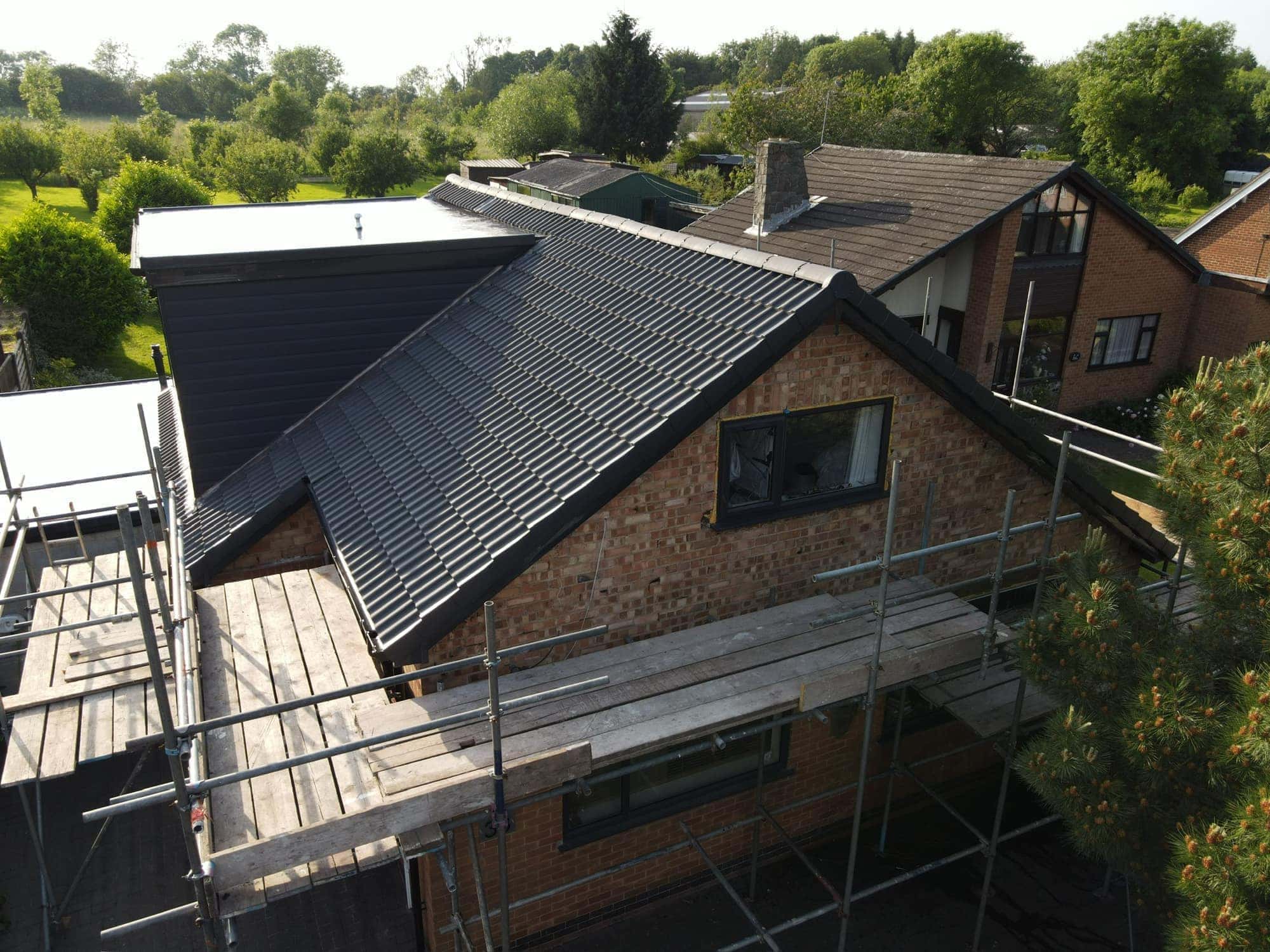
Roof Repairs in Willerby
A slipped tile rarely stays a small problem on the larger roofs found around Kerry Drive and Carr Lane, where detached and semi-detached homes often carry extensions whose junctions give leaks somewhere to hide.
Learn more →Willerby is a sought-after HU10 area with a large stock of detached and semi-detached homes and bungalows, many with sizeable roofs, and plenty of extensions added over the years around Carr Lane and Well Lane. The bungalows bring wide, low-pitched roofs that suit modern interlocking tiles when re-roofing time comes, and loft conversions make roof-window installation a regular request. Add the flat roofs on extensions and garages — felt, GRP and EPDM — and Willerby keeps us busy with a bit of everything.
Free quotes · £5 million public liability · 15-year guarantee
Main Street still holds a few houses from the village that stood here before the twentieth century. Willerby Hall, probably late seventeenth century and Grade II listed, is red brick in Flemish bond with stone dressings under a pantiled roof, and Grade II* Haltemprice Priory Farm on Abbey Lane is pantiled too. Clay pantiles from that period were laid with no underlay beneath them, and because the building is listed, new material is expected to match the old, so replacements are chosen to match colour and camber closely.
Almost everything else arrived later. Suburban building spread east towards Hull along Kingston Road and Carr Lane, well developed by the middle of the last century; streets west of the old centre had reached their present extent by the late 1960s, and further estates went up north of Carr Lane after that. Battens, underfelt and mortar bedding generally wear out well before the tiles above them do.
Ground across the parish rises from about ten metres above sea level in the east to roughly forty at the western boundary. Building has continued since: permission for 130 homes west of Great Gutter Lane came in 2015, and work on the West Hill development started in August 2016.
Three buildings here are listed: Haltemprice Priory Farm at Grade II*, with Willerby Hall and The Beeches at Grade II. Altering the character of a listed building needs listed building consent; on other houses, changing the covering, adding a front-facing roof window or taking down a chimney can also need permission. East Riding of Yorkshire Council should be asked before any materials are ordered.
Everything we do for Willerby homeowners — tap a service for local detail.
A slipped tile rarely stays a small problem on the larger roofs found around Kerry Drive and Carr Lane, where detached and semi-detached homes often carry extensions whose junctions give leaks somewhere to hide.
Learn more →Much of Willerby's housing went up in the post-war decades, and the concrete tiles laid then are now approaching the end of their working life.
Learn more →Flat roofs are everywhere in Willerby once you start looking: garages on the streets off Carr Lane, kitchen extensions behind semis near Willerby Square, and dormers cut into bungalows to win an extra bedroom.
Learn more →Sizeable pitched roofs are part of what makes Willerby's detached homes so sought after, and keeping them sound means using the right covering.
Learn more →Gales that funnel across the Wolds don't check the clock, and neither do we.
Call 07447 352091Learn more →Long gutter runs on Willerby's wider detached homes collect a lot of water, and when the timber fascias behind them start to rot, the whole roofline suffers.
Learn more →We supply and fit cast iron, cast aluminium, timber and lead guttering across Hull, Beverley and the East Riding, plus Twinplas — a twin-wall PVC box gutter made as a like-for-like replacement for the timber troughing on Victorian and Edwardian terraces — because not every roof suits white plastic.
Learn more →Twinplas is a twin-wall PVC box gutter made specifically to replace the timber trough gutters found on Victorian and Edwardian terraces and barn conversions.
Learn more →We regularly work on Grade II listed buildings across Hull, Beverley and the East Riding — from a detailed roof assessment at Lockington House, a Grade II listed former rectory, to an ongoing programme of lead work, ridge and verge work and like-for-like tile replacement on a listed property in Walkington.
Learn more →Older homes near Willerby Square still carry their original brick chimneys, and many semis along Carr Lane share a party stack that both households depend on.
Learn more →Moss thrives on the shaded, north-facing slopes of Willerby's larger roofs, and on the low-pitched bungalows around Well Lane you can often see the build-up from the street.
Learn more →Bungalow lofts around Willerby hide a surprising amount of usable space, and a well-placed Velux roof window is often the difference between a dark storage void and a bright extra room.
Learn more →Replacing a conservatory roof turns a room that bakes in summer and freezes in winter into one you can actually use all year round.
Learn more →Bay windows are a signature of the older semis around Willerby Square, and their small lead roofs quietly do a hard job for decades before splits and fatigue set in.
Learn more →Woodworm is the larva of a wood-boring beetle — in East Yorkshire homes usually the common furniture beetle — tunnelling through rafters, purlins, joists and floorboards in the roof space.
Learn more →Some of the roofs on Willerby's bigger detached homes around Kerry Drive are genuinely difficult to see from the ground, particularly where extensions add hidden valleys and rear slopes.
Learn more →As well as Willerby itself, we regularly work in Willerby Square, Kerry Drive, Carr Lane, Well Lane and across the HU10 area. Wherever you are, you get the same insured, guaranteed roofing work and an honest assessment of what your roof actually needs.
Yes — Armour Shield Roofing Services covers Willerby (HU10), including Willerby Square, Kerry Drive, Carr Lane, Well Lane. Every quote is free and no-obligation, and our workmanship is guaranteed in writing for up to 15 years.
Three buildings in the village are listed: Haltemprice Priory Farm, Willerby Hall and The Beeches. Away from those three, listed building consent will not normally apply, but changing the covering, putting a window in the front slope, or removing a chimney can still call for permission. Before any work is ordered, the council worth asking is East Riding of Yorkshire Council, which can confirm what applies to a specific address.
Growth came in phases through the twentieth century rather than in one go, with the estates north of Carr Lane arriving late in that sequence. Each phase used the coverings and fixing methods of its day, so age is the first thing to establish on any roof here. It decides whether the covering is clay, concrete or slate, and whether ridges and verges were bedded in mortar or mechanically fixed.
West Hill, west of Great Gutter Lane, was granted permission in 2015 and building started in August 2016. New estate roofs of that period are generally concrete interlocking tiles with dry-fixed ridges and verges, so there is little mortar to crack. What they still need is what any roof needs: gutters kept clear, flashings checked, and moss dealt with before it beds into shaded slopes.
Free, no-obligation quote — usually the same working day.
Loading the quick form… If it doesn't appear, call 07447 352091 and we'll take the details over the phone.