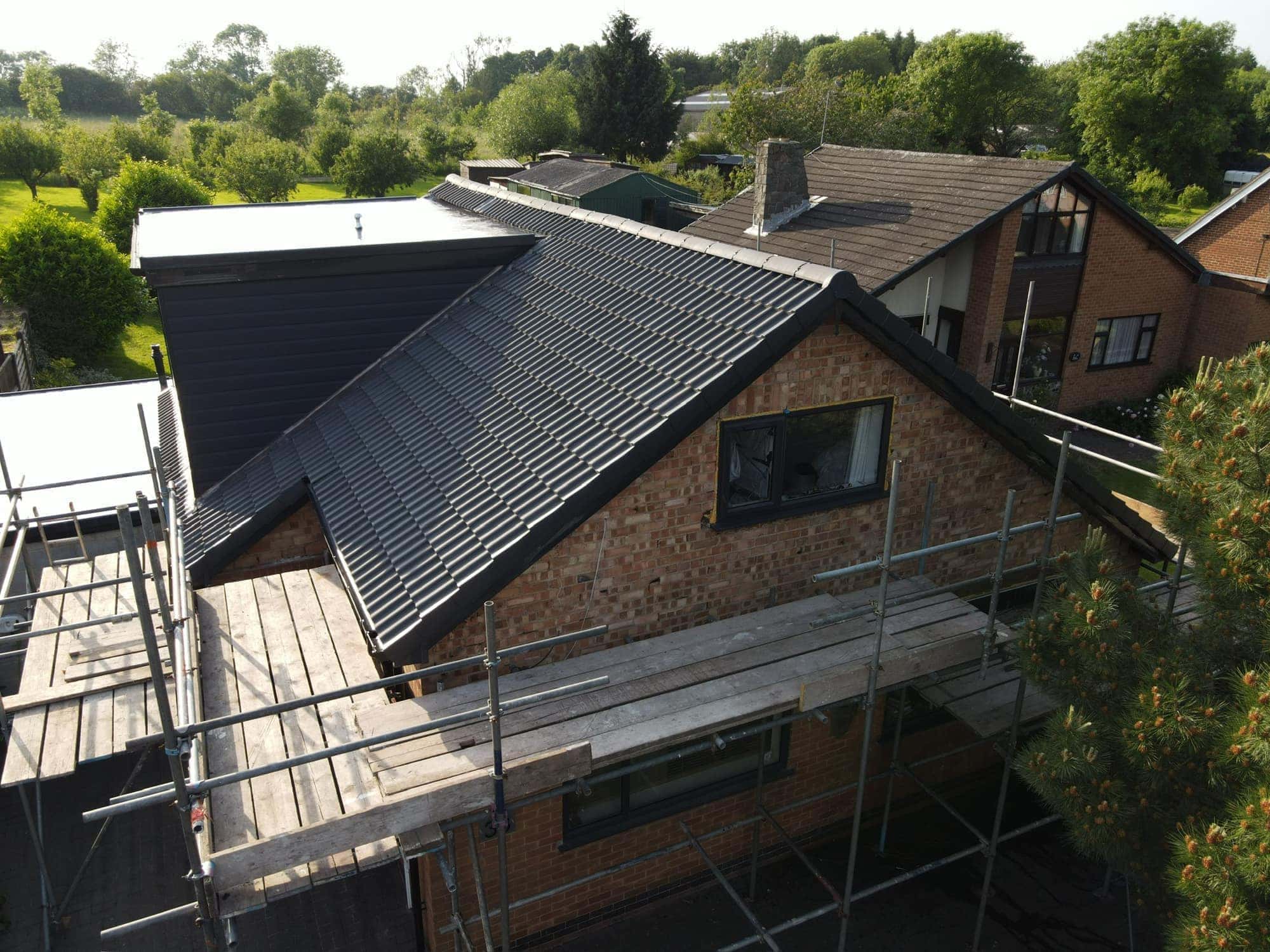
Roof Repairs in Pocklington
Weather rolling off the Wolds escarpment gives Pocklington roofs a harder life than most, so slipped pantiles, cracked tiles and worn flashings tend to show up sooner here.
Learn more →Pocklington is a market town at the foot of the Yorkshire Wolds in the YO42 area, with a mix of period brick properties under Welsh slate and clay pantile, and modern estates. Rural and village roofs around Pocklington often need pantile matching, chimney repairs and full re-roofs.
Free quotes · £5 million public liability · 15-year guarantee
Brick accounts for the great majority of buildings in the conservation area, in colours from grey and gault through brown and gold to Victorian red. Both of the East Riding's traditional coverings sit above it, and the council's appraisal picks out Welsh slate rather than pantile as part of the town's special character. Slate arrived in quantity only once the railways could shift heavy loads, the station of 1847 being the usual marker.
Two storeys is the norm in the conservation area, though three-storey buildings are far from rare — from modest town cottages to houses whose stature was meant to impress. The council's appraisal describes the centre as a series of squares entered corner to corner.
Concrete tiles turn up in the area as well, and since they lose their colour over the years the appraisal treats the older ones as easy to spot. The town itself is a spring line settlement: flat arable land lies south and west of it, grassy chalk hills and dry valleys north and east. Open ground offers a roof less shelter than a street of close neighbours.
Pocklington's conservation area was designated in 1974 and takes in some 325 dwellings and 11 listed buildings. The town's listed buildings include the Grade I All Saints Church on Pavement. A change of covering, added roof windows or a chimney taken down can need planning permission and listed building consent, so ask East Riding of Yorkshire Council, the planning authority here, before work goes ahead.
Everything we do for Pocklington homeowners — tap a service for local detail.
Weather rolling off the Wolds escarpment gives Pocklington roofs a harder life than most, so slipped pantiles, cracked tiles and worn flashings tend to show up sooner here.
Learn more →Many of Pocklington's period brick properties, roofed in Welsh slate or clay pantile, are now carrying roofs well past their design life, and a full re-roof is often more economical than repeated patching.
Learn more →Extensions and garages on Pocklington's modern estates often rely on ageing felt that has blistered or started to pond, while dormers on the town's older houses can suffer the same fate.
Learn more →Clay pantiles define the look of Pocklington's older streets, and matching them properly matters when a pitched roof needs renewing.
Learn more →When a gale funnels down off the Wolds and strips tiles at midnight, Pocklington homeowners need someone who answers the phone.
Call 07447 352091Learn more →Timber rooflines on Pocklington's mid-century homes were never built for decades of Wolds-edge rain, and rot in fascias and soffits eventually lets water into the roof structure itself.
Learn more →We supply and fit cast iron, cast aluminium, timber and lead guttering across Hull, Beverley and the East Riding, plus Twinplas — a twin-wall PVC box gutter made as a like-for-like replacement for the timber troughing on Victorian and Edwardian terraces — because not every roof suits white plastic.
Learn more →Twinplas is a twin-wall PVC box gutter made specifically to replace the timber trough gutters found on Victorian and Edwardian terraces and barn conversions.
Learn more →We regularly work on Grade II listed buildings across Hull, Beverley and the East Riding — from a detailed roof assessment at Lockington House, a Grade II listed former rectory, to an ongoing programme of lead work, ridge and verge work and like-for-like tile replacement on a listed property in Walkington.
Learn more →Stone and brick chimneys on Pocklington's period properties face the full force of weather coming off the Wolds, and failed pointing or cracked flaunching lets damp track straight into the bedrooms below.
Learn more →Sitting under the western edge of the Wolds, Pocklington's roofs collect moss quickly on shaded, north-facing pitches — particularly older pantile roofs near the town centre and tree-lined properties out towards Allerthorpe.
Learn more →Turning an unused loft into a bright, usable room is one of the most requested jobs in Pocklington — it adds space without losing any garden.
Learn more →Replacing a conservatory roof turns a room that bakes in summer and freezes in winter into one you can actually use all year round.
Learn more →Traditional leadwork suits Pocklington's period slate and pantile roofs far better than modern substitutes, and we detail it to code — proper thicknesses, correct fixings, sensible bay sizes.
Learn more →Woodworm is the larva of a wood-boring beetle — in East Yorkshire homes usually the common furniture beetle — tunnelling through rafters, purlins, joists and floorboards in the roof space.
Learn more →Some of Pocklington's taller period properties and steep Wolds-facing pitches are awkward to survey from a ladder, which is where our CAA-registered drone earns its keep.
Learn more →As well as Pocklington itself, we regularly work in Barmby Moor, Stamford Bridge, Wilberfoss, Allerthorpe and across the YO42 area. Wherever you are, you get the same insured, guaranteed roofing work and an honest assessment of what your roof actually needs.
“Would highly recommend. Quick reply, quick turn around of the job and everything done to a high standard. Thank you so much”
Yes — Armour Shield Roofing Services covers Pocklington (YO42), including Barmby Moor, Stamford Bridge, Wilberfoss, Allerthorpe. Every quote is free and no-obligation, and our workmanship is guaranteed in writing for up to 15 years.
A dry verge along the gable of a detached home in Pocklington (YO42) had lifted and come away in the wind. We stripped back the loose sections and refitted the verge mechanically — properly clipped and secured — so the edge is watertight again and will hold through the next storm.
Both of the East Riding's traditional coverings are readily found here, but the council's appraisal singles out Welsh slate rather than pantile as part of the town's special character. Slate was not used widely in the East Riding until the railways made heavy goods easier to move, and the station of 1847 is taken as the pointer to when that began. Roofs of that age often fail through nail fatigue rather than broken slates.
Possibly — it depends on the property. Listed buildings inside the conservation area normally need listed building consent for alterations affecting their character, on top of any planning permission. Elsewhere in it, like-for-like materials are usually what a council expects, though the position varies from address to address. The planning authority here is East Riding of Yorkshire Council, which published the town's conservation area appraisal back in 2009, worth asking them before ordering materials.
Three-storey buildings are more numerous here than in most East Riding settlements, and on one of those a ladder is rarely the right way to reach the work — a tower or a scaffold usually is. Where scaffolding stands over a public footway or a road, the highway authority has to licence it first. A drone survey can establish what is actually wrong before anything is put up.
Free, no-obligation quote — usually the same working day.
Loading the quick form… If it doesn't appear, call 07447 352091 and we'll take the details over the phone.