Twinplas Guttering Explained: Replacing a Timber Trough Gutter
By Leonard Walton, owner & lead roofer12 min read
Many older terraces in Beverley, York and Hull were built with a timber trough gutter — a wooden box gutter resting at the top of the wall — instead of the plastic guttering you see on modern houses. When that timber finally rots, ordinary guttering usually won't fit in its place. Twinplas is the product made for exactly this job: a twin-wall PVC box gutter the same shape and size as a timber trough, which drops into the same position, cannot rot and never needs painting. We fit Twinplas across Beverley, York, Hull and the East Riding.
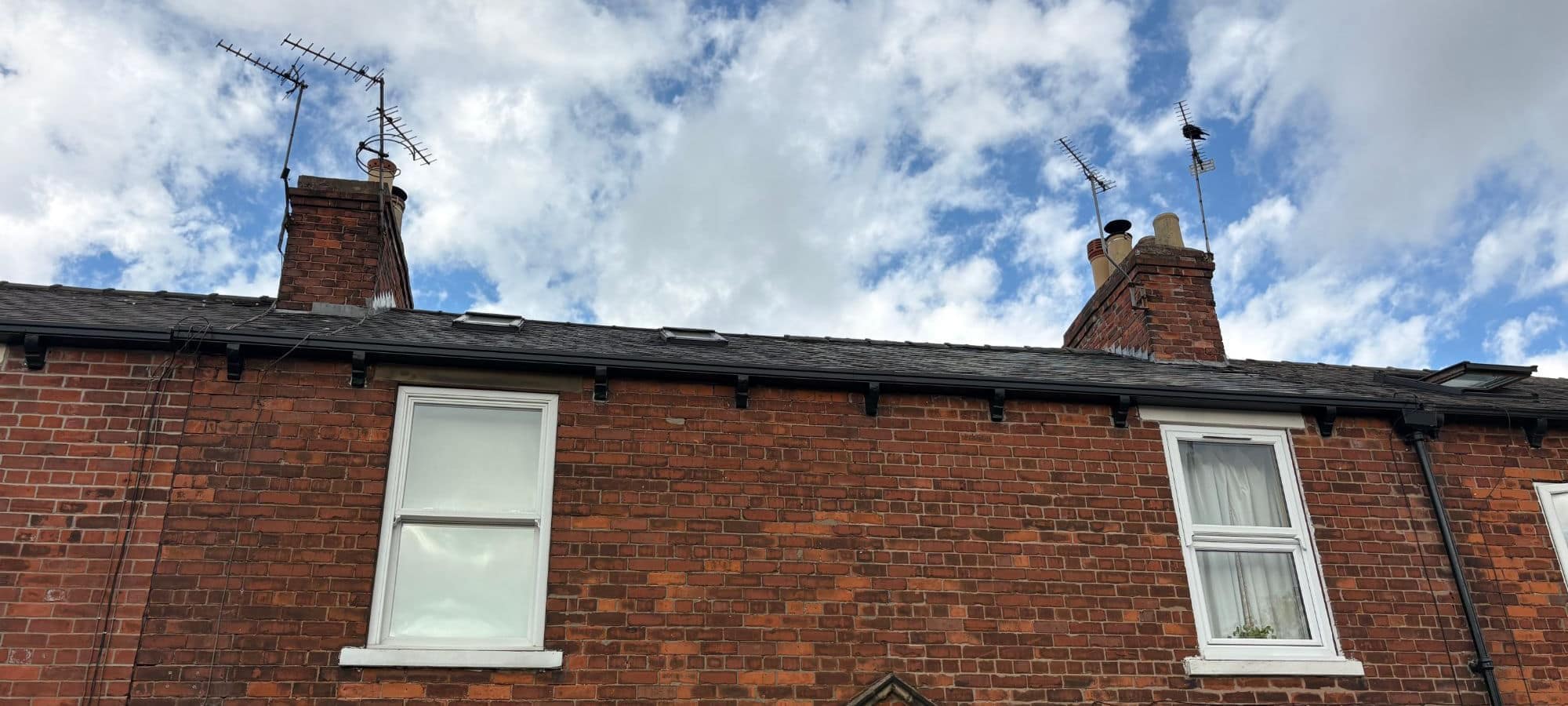
A recent Twinplas job in Beverley
In September 2026 we replaced the rotten timber trough running across two terraced houses near Queensgate, Beverley, with a 9-metre run of Twinplas. The timber corbels that carried the old trough had to be replaced with new ones before the gutter could go in, so that it could be set to the correct falls and would stay there — a good example of why the survey looks at what is holding the gutter up, not just the gutter itself. The whole job, corbels included, was finished in a day.
“Leonard did an excellent job replacing our wooden gutters with plastic ones which look in keeping. He was great to work with, got the job done quickly and we are really happy with the results. I would highly recommend his work.” — Sarah Burton, Google review
“They did an excellent job replacing our wooden gutter with a sympathetic PVC version that is in keeping with the area and newly fitted wooden corbels. It was obvious that Leonard understood his craft and the nuances of older homes. … I would thoroughly recommend Armour Shield for your roofing and gutter needs.” — Ellen Ricketts, Google review
What is a timber trough gutter?
A trough is a long wooden box, open at the top, that sits under the edge of the slates or tiles and catches the rainwater. On Victorian and Edwardian terraces across Hull, Beverley and the East Riding it typically rests on brick or stone corbels or iron brackets at the top of the wall, often running in one continuous line across several houses. There is usually no fascia board behind it, which matters when it comes to replacing it.
Timber troughs were lined or painted inside to keep the water off the wood. Once that protection fails the timber stays wet, and rot follows.
Signs a timber trough is failing
- Water dripping or pouring from the underside or the joints when it rains
- Green or dark staining running down the brickwork below the gutter
- Damp patches at the top of a bedroom wall or ceiling, just inside the eaves
- The trough sagging, twisting or pulling away from the wall
- Soft, crumbling or split timber, or plants growing in the gutter line
Left alone, a leaking trough soaks the top of the wall and the ends of the roof timbers, so a gutter problem becomes a roof repair and a damp problem too.
Why ordinary plastic guttering usually won't do
Standard half-round or square uPVC guttering is designed to hang from a fascia board on clips. A terrace built with a trough normally has no fascia, and the roof edge is set out for a gutter of a particular size sitting in a particular place. Forcing ordinary guttering on usually means altering the roof edge or adding boards that were never part of the house — and it rarely looks right next to the neighbours' troughs on the same row.
What Twinplas is
Twinplas is a twin-wall PVC box-gutter profile made specifically as a replacement for timber troughing on terraced housing and barn conversions.
| Twinplas | |
|---|---|
| Material | Twin-wall PVC, stiffened by internal webs |
| Weight | Under 3 kg per metre |
| Lengths | 3 m, 5 m and 6 m |
| Joints | Sleeve connectors with factory-fitted rubber gasket seals |
| Fittings | Outlets, mitre corners and brackets made for the system |
| Upkeep | No painting; cannot rot or rust |
Because it matches the size and position of a timber trough, it goes back where the old gutter was and the roof edge is left as built. Long lengths mean fewer joints across a terrace frontage, and fewer joints means fewer places to leak.
Timber, Twinplas or something else?
Repair the trough where the timber is still sound — a section can be replaced and the trough relined. Replace like-for-like in timber where a listing or a conservation condition calls for the original material. Fit Twinplas where you want the traditional box-gutter line without the rot and the repainting — for most unlisted terraces it is the practical long-term answer. On grander period houses the right choice may instead be cast iron, cast aluminium or a lead-lined gutter; we fit all of them and will tell you honestly which suits the house.
Timber trough replacement options
The replacement options we fit, side by side. The Twinplas figure is a guide; every job is quoted fixed in writing after a free survey.
| Material | Looks from the street | Weight | Maintenance | Suits | Cost |
|---|---|---|---|---|---|
| Twinplas twin-wall PVC | The traditional box-gutter line, in the trough's own position | Under 3 kg per metre | No painting; cannot rot or rust. Clear leaves and moss once or twice a year | Most unlisted terraces, and barn conversions | Around £1,000 per side of a terraced house, supplied and fitted |
| Like-for-like lined timber | The original material and trough line | — | Lined so water never sits on bare wood; once that lining fails, rot follows | Listed buildings and conservation conditions that call for the original material | Quoted after a free survey |
| Cast iron | Traditional moulded profiles: half-round, ogee or box | Heavy | Repainting every few years to hold off rust at the joints | Victorian and Edwardian homes; the usual requirement on listed buildings | Quoted after a free survey |
| Cast aluminium | The same heritage profiles as cast iron | Roughly a third of the weight of cast iron | Powder-coated at the factory; does not rust and never needs repainting | Period homes where the look matters but upkeep must be low | Quoted after a free survey |
| Lead-lined timber | The original box or parapet gutter line, with the lead laid in bays inside it | Heavy | Outlasts every other gutter material; a theft target, so we can advise on marking | Grander period houses, and the churches, halls and older town houses where a listing calls for lead | Quoted after a free survey |
How we fit it
- Survey. We inspect the trough, its supports and the wall and roof edge behind it, measure the falls and outlet positions, and check whether any listing or conservation condition applies.
- Fixed written quote. One clear figure, including any timber or masonry repair behind the gutter. Surveys and quotes are free.
- Installation. The failed trough comes out, the supports and any timber behind are repaired or renewed, and the Twinplas is set to proper falls and sealed at every joint, with new outlets and downpipes where needed.
- Water test and handover. Every run is water-tested through to the downpipes and photographed at handover.
The work is done by our own directly employed team — we never subcontract — and is covered by our workmanship guarantee and £5 million public liability insurance.
Twinplas in Beverley and York's conservation areas
Much of central Beverley is a conservation area, and the town has a large number of listed buildings; the same is true of York inside and around the city walls, where the Victorian terraces of Fishergate, South Bank and Heworth often still carry their original troughs. On an ordinary unlisted house you do not need permission to renew a gutter. On a listed building, changing the gutter material needs listed building consent, and in a conservation area an Article 4 direction can restrict changes to the front of a house. We check what applies before you commit to anything. Where the original material has to stay we fit timber, cast iron, cast aluminium or lead instead — we work on Grade II listed buildings regularly.
Frequently asked questions
What is Twinplas guttering?
Twinplas is a twin-wall PVC box gutter made specifically to replace the timber trough gutters found on Victorian and Edwardian terraces and on barn conversions. It is the same shape and size as a wooden trough, so it sits in the same position at the top of the wall, but it cannot rot and never needs painting. It comes in 3, 5 and 6 metre lengths and weighs under 3 kg per metre.
Who fits Twinplas guttering in Yorkshire?
Armour Shield Roofing Services fits Twinplas guttering anywhere in Yorkshire, including Leeds, York, Sheffield, Wakefield, Huddersfield, Halifax, Doncaster, Harrogate, Hull, Scarborough, Beverley (HU17) and the East Riding, with no minimum job size. Leeds in particular has a great deal of Twinplas and timber trough guttering on its older terraces — see Twinplas guttering in Leeds, and our Twinplas pages for York, Sheffield and Harrogate. In September 2026 we replaced the timber trough across two terraced houses near Queensgate, Beverley, with a 9-metre run of Twinplas. Surveys and written quotes are free, and the work is carried out by our own directly employed team and covered by our workmanship guarantee.
How much does Twinplas guttering cost?
As a guide, replacing a timber trough with Twinplas costs around £1,000 per side of a terraced house — front or back — supplied and fitted, including removing the old trough. Replacing the corbels or brackets beneath it, or renewing downpipes, adds to that. Every job is quoted fixed in writing after a free survey, and our roofing costs page lists our other typical prices.
Can a timber trough gutter be replaced with ordinary plastic guttering?
Usually not. Ordinary half-round or square uPVC guttering hangs from a fascia board, and a terrace built with a timber trough normally has no fascia — the trough rests at the top of the wall on corbels or brackets. Twinplas is a box profile made to go where the trough was, so the roof edge does not have to be altered.
Should I repair my timber trough or replace it with Twinplas?
If the timber is still sound, a trough can be repaired and relined. If it is soft, sagging or leaking along its length, replacement is the better money. A new timber trough keeps the original material, which a listing may require; Twinplas gives the same look from the street with no rot and no painting.
Does Twinplas need any maintenance?
Very little. It is PVC, so there is nothing to rot, rust or repaint. Like any gutter it should be cleared of leaves and moss once or twice a year so the outlets and downpipes stay open.
Do I need permission to fit Twinplas in a conservation area?
On an ordinary house, no. On a listed building, changing the gutter material needs listed building consent, and in a conservation area an Article 4 direction can restrict changes to the front of a house. Much of central Beverley and York is covered by conservation areas, so we check what applies to your property before you commit, and we fit timber, cast iron, cast aluminium or lead where the original material has to be kept.
Why is a new Twinplas gutter leaking at the joint?
Twinplas lengths are joined with sleeve connectors that carry a factory-fitted rubber gasket, so a joint that leaks soon after fitting is almost always a fitting fault: a gasket not seated, a gutter end not cut square, no allowance left for the gutter to expand, or a run laid without a proper fall, so water sits at the joint instead of running to the outlet. When we fit Twinplas, the falls are set along the full run, every joint is seated and the whole run is water-tested through to the downpipes at handover, and the work is covered by our 15-year written workmanship guarantee.
What happens to the old corbels or brackets?
They are surveyed first, because the supports decide whether the new gutter can be set to the correct falls and stay there. Where the timber corbels have rotted, as they had on the Queensgate job in Beverley, they are renewed in new timber before the Twinplas run goes on. Sound supports — brick or stone corbels and iron brackets — are kept, and the new gutter sits on them.
How long does a Twinplas job take?
It depends on the length of the run and the state of the supports. Our Queensgate job in Beverley — a 9-metre run across two terraced houses, with the rotten timber corbels renewed first — was fitted in one day. Longer runs, whole terraces and barn conversions are quoted after a free survey.
Can I fit Twinplas myself?
Twinplas is sold to the trade and to the public, so you can buy it. Where it goes wrong is at the joints, in the falls along the run, and in the fixings into old brickwork at the top of the wall — all of it done at height. When we fit it, the falls are set along the whole run, every joint is seated, the run is water-tested through to the downpipes at handover, and the work carries our 15-year written workmanship guarantee.
Can Twinplas go on a barn conversion or a house with stone corbels?
Yes to both. Twinplas was made to replace timber troughing on barn conversions as well as on Victorian and Edwardian terraces. On a house with stone corbels it goes where the trough sat, on the sound or repaired supports: in Leeds the timber gutters rest on brick or stone corbels at the wall head, in Harrogate on stone or timber modillions, and Twinplas sits on them in the same position. The survey checks the supports and the wall behind them before anything is ordered.
Twinplas guttering city by city
Each of our Yorkshire city pages covers that city's own terraces and conservation areas: Twinplas guttering in Leeds, Twinplas guttering in York, Twinplas guttering in Sheffield and Twinplas guttering in Harrogate.
Got a leaking or rotten trough gutter in Leeds, York, Sheffield, Hull or anywhere else in Yorkshire? Get in touch for a free survey and a fixed written quote.